

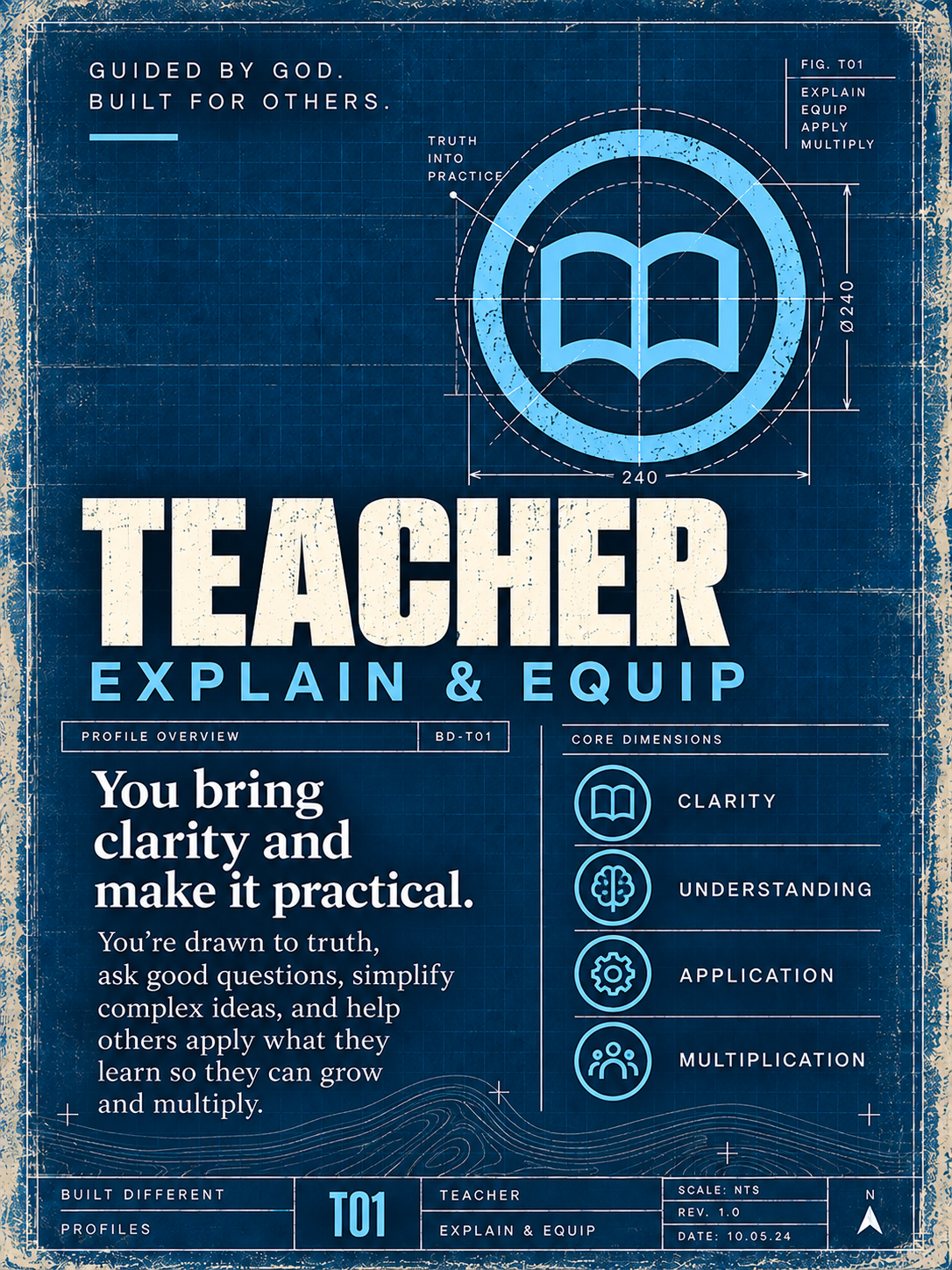
Teacher · Understand & Explain
Ephesians 4:11-13 (ESV)
“And he gave the apostles, the prophets, the evangelists, the shepherds and teachers, to equip the saints for the work of ministry, for building up the body of Christ, until we all attain to the unity of the faith and of the knowledge of the Son of God, to mature manhood, to the measure of the stature of the fullness of Christ”
You tend to notice what isn't understood.
You notice when something doesn't quite make sense.
An explanation may sound convincing, but you're still asking how the pieces fit together. Someone may be struggling with an idea, and you instinctively start thinking about another way to explain it.
You want to understand things for yourself—but it usually doesn't stop there.
Once something becomes clear to you, you naturally begin looking for ways to make it clear to someone else.
You break complicated ideas into smaller pieces. You use examples and comparisons. You ask questions. You care whether what you're saying is actually accurate.
And ultimately, you want people to understand well enough that they don't need you to keep explaining it.
That's the heart of the Understand & Explain contribution.
WHAT YOU BRING
Teaching contribution helps move people from confusion toward understanding.
You tend to ask questions like:
- Does this actually make sense?
- How do these ideas fit together?
- Is there a clearer way to explain this?
- Can he use what he's learned without me?
You may find yourself digging deeper into something others are willing to accept at face value, organizing complicated information, finding an illustration that suddenly makes an idea click, or helping someone understand something well enough that he can explain it to somebody else.
Your contribution isn't simply knowing things.
It's pursuing understanding and then turning what you've learned into something clear, accurate, and useful for others.
YOUR BLUEPRINT
CURIOSITY — You seek it.
Your attention naturally goes toward understanding.
When you encounter something new, you don't only want to know what is true. You often want to understand why it makes sense and how it fits together.
Questions don't necessarily bother you.
They give you somewhere to dig.
Where others may be satisfied knowing the answer, you often want to understand what's behind it.
CLARITY — You explain it.
Once you understand something, your instinct is often to make it understandable to someone else.
When an explanation isn't landing, you look for another way.
You break complicated ideas into smaller pieces. You reach for an example, comparison, story, or illustration that gives someone a way to grasp what previously seemed confusing.
You don't just want to say it correctly.
You want the other person to get it.
ACCURACY — You test it.
Clarity matters, but so does truth.
Before repeating something as fact, you want to know whether it can actually be supported. When an explanation sounds convincing but leaves out an important detail, you tend to notice.
You understand that a simple explanation isn't helpful if it isn't accurate.
At your best, you hold both together:
Make it clear without making it untrue.
EQUIPPING — You give it away.
The goal isn't for people to remain dependent on your explanation.
It's for them to understand it for themselves.
You want someone to take what he's learned and use it without needing you standing beside him. And one of the clearest signs that learning has taken root is when he can turn around and help someone else understand it too.
You haven't merely transferred information.
You've equipped someone else to carry it.
WHEN YOU'RE AT YOUR BEST
At your best, you bring understanding and clarity.
You help people make sense of things that once felt confusing or inaccessible. You ask questions that expose gaps in understanding. You organize ideas, find connections, and give people language for things they may have struggled to articulate.
You don't merely give people answers.
You help them learn how to understand.
And perhaps one of the greatest expressions of your contribution happens when something you taught travels beyond you:
Someone you equipped begins equipping someone else.
That's why this contribution matters to the Kingdom.
Throughout Scripture, God's people are repeatedly called not only to know his truth, but to understand it, live by it, and pass it on to others. Jesus taught in ways people could grasp, asked questions that made them think, explained the Scriptures, and prepared his disciples to teach others.
In Ephesians 4, Paul places the teaching contribution alongside the other gifts Christ gives for the equipping and building up of his people.
The goal isn't simply knowing more.
It's helping the body become grounded in truth, equipped for ministry, and mature in Christ.
WATCH YOUR BLINDSIDE
Every strength can become distorted when it operates alone.
Because understanding matters to you, you may keep researching long after you know enough to act.
Because accuracy matters, you can become distracted by details that aren't actually important to the person you're helping.
Because you enjoy making things clear, you may give an explanation when what someone really needs is a conversation.
And because knowledge comes naturally to you, you may forget what it felt like not to know.
There's another danger for someone wired toward understanding:
You can mistake knowing something for living it.
Healthy Understand & Explain contribution remembers that truth is meant to form people, not merely inform them. Accuracy without humility can become arrogance.
Information without application can remain sterile. And the best explanation in the world accomplishes little if it never changes how someone lives.
Sometimes faithfulness means understanding more.
Sometimes it means doing something with what you already understand.
You weren't meant to do this alone.
Your contribution gets stronger when it works alongside the others.
The Kingdom doesn't need five versions of you. It needs each of us bringing what God has given us for the good of the whole body.


How Are You Built Different?
Discover the way you naturally strengthen others and contribute to the Kingdom.
Take The Built Different Assessment Learn More