

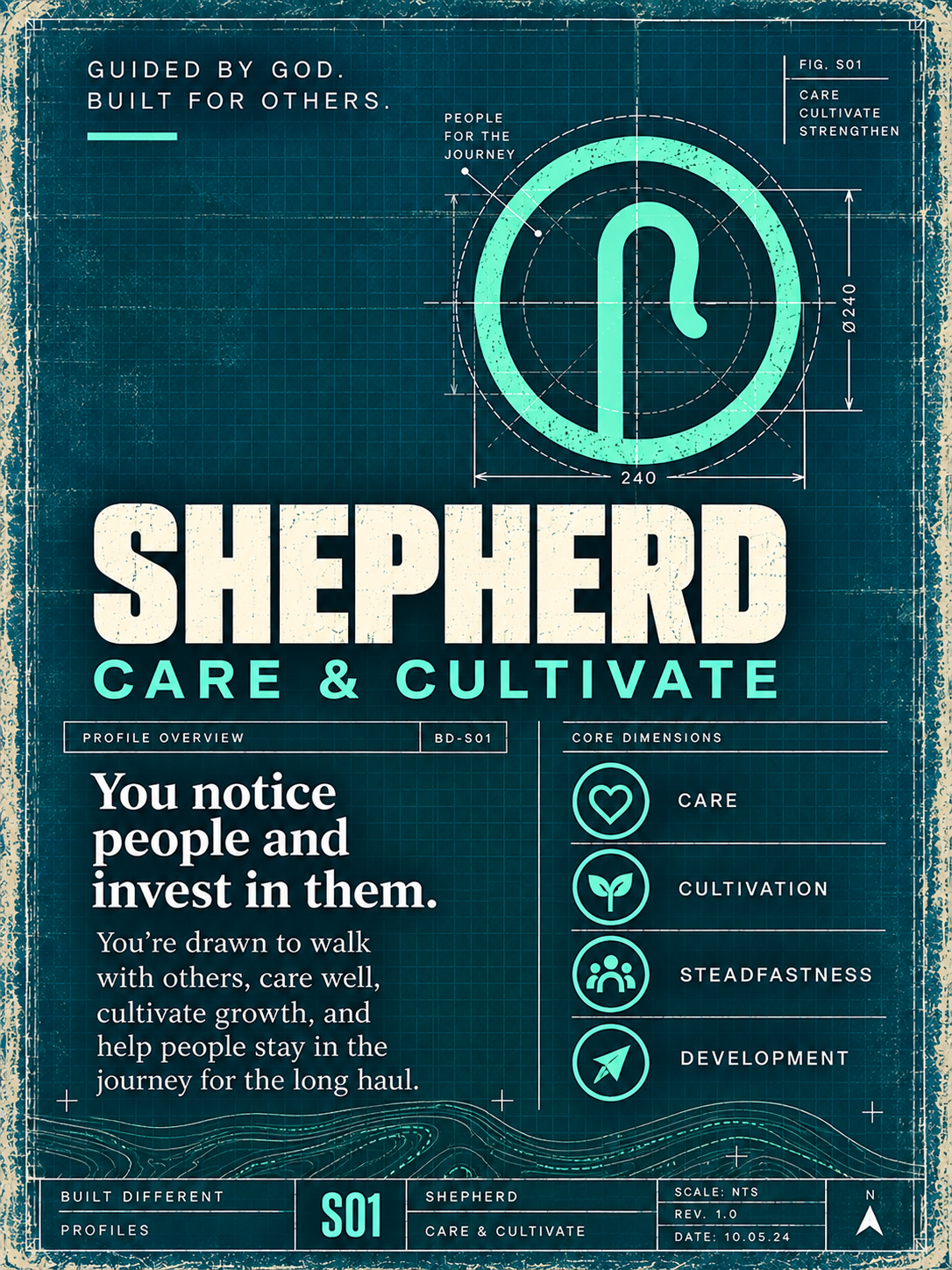
Shepherd · Know & Care
Ephesians 4:11-13 (ESV)
“And he gave the apostles, the prophets, the evangelists, the shepherds and teachers, to equip the saints for the work of ministry, for building up the body of Christ, until we all attain to the unity of the faith and of the knowledge of the Son of God, to mature manhood, to the measure of the stature of the fullness of Christ”
You tend to notice how people are really doing.
You notice when someone doesn't seem like himself.
You recognize when the guy who normally shows up suddenly disappears. You remember what someone told you weeks ago and find yourself wondering how things turned out.
And when you realize someone is struggling, your instinct is often to move toward him.
You don't necessarily need to solve the problem. You're willing to be present, walk alongside him, and make sure he doesn't have to carry it alone.
And when the road gets long or messy, you tend to stay.
That's the heart of the Know & Care contribution.
WHAT YOU BRING
Shepherding contribution helps people move from being noticed to being known and cared for.
You tend to ask questions like:
- How is he really doing?
- Why hasn't he been around lately?
- Does somebody need to check on him?
- Who's walking with him through this?
You may find yourself remembering details others have forgotten, reaching out when someone disappears, sitting with a friend through a difficult season, protecting a vulnerable person, or staying invested when growth takes longer than anyone expected.
Your contribution isn't simply being a caring person.
It's paying attention to people closely enough to know them, move toward them, protect what matters, and stay when life gets difficult.
YOUR BLUEPRINT
ATTENTIVENESS — You notice him.
Your attention naturally goes toward the person.
You recognize changes in people—the man who seems quieter than usual, the friend who suddenly stops showing up, the person whose words say he's fine but whose demeanor tells a different story.
You also tend to remember the things people have trusted you with.
Where others may see the group, you often notice the individual within it.
PRESENCE — You move toward him.
Noticing creates a response.
When you realize someone is struggling, your instinct is often to move toward him rather than waiting for him to ask for help.
And when someone opens up, you don't necessarily need to rush the conversation toward a solution.
Sometimes the most important thing you bring is simple:
You're there.
PROTECTION — You stand with him.
Care makes you attentive to vulnerability.
When someone you care about is struggling, you don't want him facing it alone. When conflict begins damaging relationships, you naturally want to keep those relationships from breaking apart.
Healthy protection isn't controlling someone's life or shielding him from every consequence.
It's communicating through your presence:
“You don't have to face this by yourself.”
STEADINESS — You stay.
Some relationships are easy to enter and difficult to maintain.
This is where your contribution becomes especially important.
You're often willing to keep walking with someone when progress is slower, harder, or messier than expected. Once you're invested in a person's life, difficulty doesn't automatically make you disappear.
You don't only show up for the breakthrough.
You stay for the process.
WHEN YOU'RE AT YOUR BEST
At your best, you bring presence and steadiness.
You help create communities where people are more than names in a room. You remember stories. You notice absences. You make it safer for people to be honest about what's happening beneath the surface.
You help people know that their struggles don't make them a burden and that growth doesn't have to happen alone.
Perhaps one of the greatest expressions of your contribution is that people can look back on a difficult season and say:
“He stayed.”
That's why this contribution matters to the Kingdom.
Throughout Scripture, God repeatedly describes his care for his people through the image of a shepherd—one who knows, leads, protects, seeks, and stays with the flock. Jesus takes that image upon himself when he calls himself the Good Shepherd.
In Ephesians 4, Paul places the shepherding contribution alongside the other gifts Christ gives for the equipping and building up of his people.
The goal isn't simply making people feel cared for.
It's helping create a body where people are known, strengthened, and able to grow toward maturity together.
WATCH YOUR BLINDSIDE
Every strength can become distorted when it operates alone.
Because you care deeply about people, you may begin carrying responsibility that belongs to them.
Because relationships matter to you, necessary conflict can feel like a threat to the relationship rather than an opportunity for growth.
Because you don't want someone facing difficulty alone, you may step in so quickly that you keep him from developing the strength to carry something himself.
And because staying comes naturally, you may remain in situations long after your role needs to change.
There's another danger for someone wired toward care:
You can become needed instead of becoming helpful.
Healthy Know & Care contribution learns that loving someone doesn't mean rescuing him from every difficulty. Presence doesn't require fixing. Protection doesn't mean control. And faithfulness doesn't always mean carrying the same weight forever.
Sometimes love means walking beside someone.
Sometimes it means letting him take the next step himself.
You weren't meant to do this alone.
Your contribution gets stronger when it works alongside the others.
The Kingdom doesn't need five versions of you. It needs each of us bringing what God has given us for the good of the whole body.


How Are You Built Different?
Discover the way you naturally strengthen others and contribute to the Kingdom.
Take The Built Different Assessment Learn More