

Prophet · Discern & Align
Ephesians 4:11-13 (ESV)
“And he gave the apostles, the prophets, the evangelists, the shepherds and teachers, to equip the saints for the work of ministry, for building up the body of Christ, until we all attain to the unity of the faith and of the knowledge of the Son of God, to mature manhood, to the measure of the stature of the fullness of Christ”
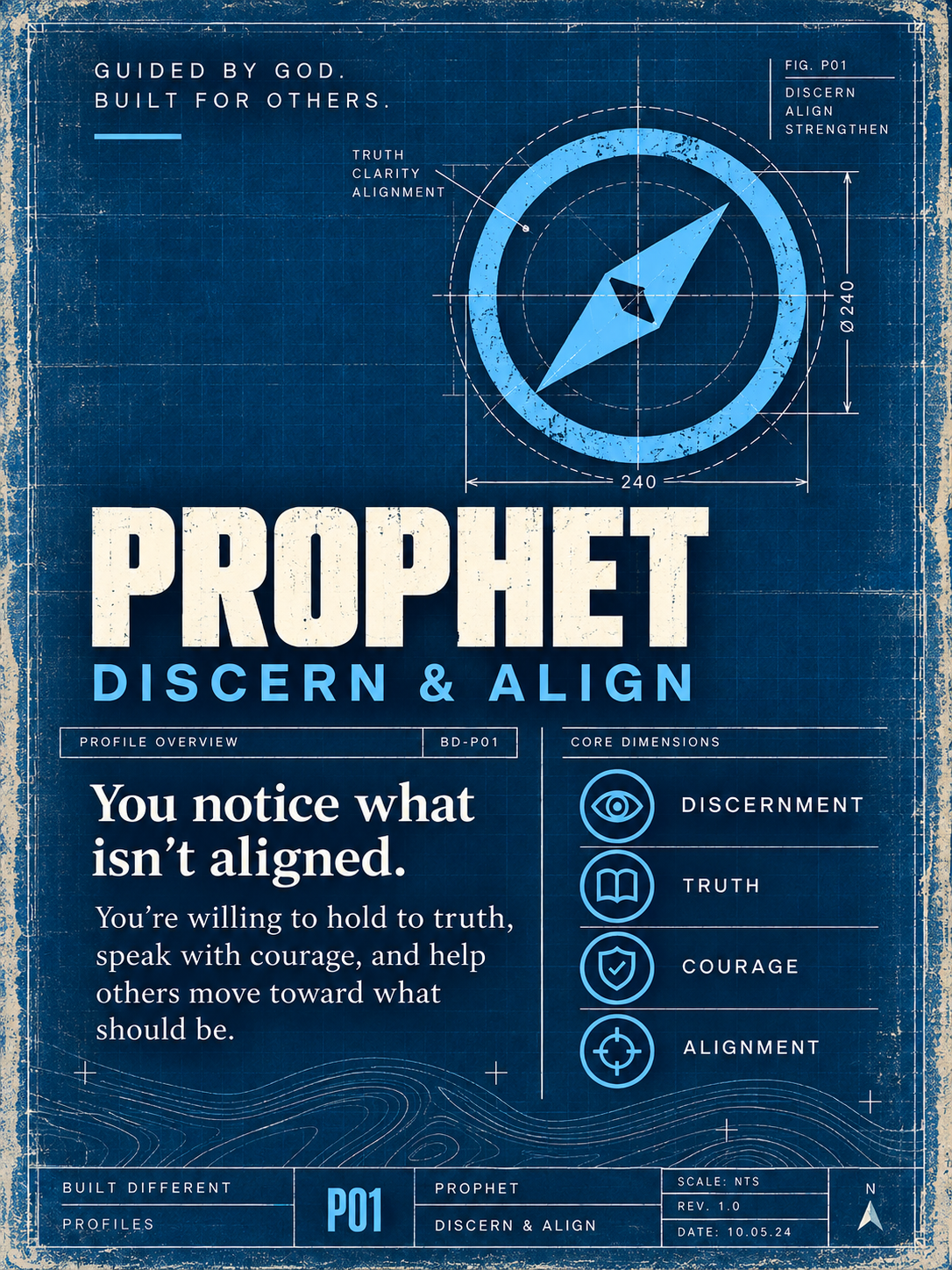
You tend to recognize when something is off.
Between what people say and how they live. What a group says matters and what it actually prioritizes. What something was intended to be and what it has slowly become.
Sometimes everything can look fine on the surface, but you sense the disconnect underneath.
And once you see it, it can be difficult to ignore.
You’re not necessarily looking for problems. You simply have an instinct for alignment—and when something important has drifted, you want to help bring it back.
That’s the heart of the Discern & Align contribution.
WHAT YOU BRING
Prophetic contribution helps people move from drift back toward alignment.
You tend to ask questions like:
- Is this actually true?
- Are we living what we say we believe?
- Have we drifted from what matters?
- Does somebody need to say something?
You may find yourself recognizing inconsistencies others have learned to overlook, holding onto a conviction when it would be easier to compromise, saying something difficult that needs to be said, or reminding people why they started in the first place.
Your contribution isn't predicting the future. And it isn't simply pointing out what's wrong.
It's helping people recognize what matters and realign their lives around it.
YOUR BLUEPRINT
DISCERNMENT — You notice it.
Your attention naturally goes toward what doesn’t quite fit.
You often recognize the gap between what is said and what is actually happening. You may sense when something has shifted beneath the surface or when a group has slowly drifted from its original purpose.
Where others may accept things as they are, you instinctively ask whether they are as they should be.
CONVICTION — You hold it.
Once you believe something is true or important, you don't easily let it go simply because holding onto it becomes uncomfortable.
You would rather wrestle with an inconvenient truth than make peace with something you believe is wrong.
At your best, conviction gives you an anchor.
You know what matters, and you hold to it.
COURAGE — You say it.
Eventually, discernment and conviction create a decision:
Will I speak?
When something important is being compromised, you may feel a responsibility to name it—even when you know doing so could create tension.
Healthy courage isn't about enjoying confrontation or proving that you're right.
It's being willing to say what needs to be said because it matters.
ALIGNMENT — You call people back.
The goal isn't merely identifying the problem.
It's realignment.
You naturally find yourself reminding people what they said mattered, helping someone recognize where his choices are taking him, or calling a group back toward its purpose.
You don't just want people to see the gap.
You want to help close it.
WHEN YOU’RE AT YOUR BEST
At your best, you bring clarity and conviction.
You help people see things they may have missed—or avoided. You keep important truths from becoming negotiable simply because circumstances have changed. You ask whether our actions actually match what we claim to believe.
And you're willing to care enough about people to tell them something they may not want to hear.
That's why this contribution matters to the Kingdom.
Throughout Scripture, God's people repeatedly needed voices willing to call them back—not merely to criticize their failures, but to remind them who they were, who God is, and how they were called to live.
In Ephesians 4, Paul places the prophetic contribution alongside the other gifts Christ gives for the equipping and building up of his people.
The goal isn't being the loudest voice in the room.
It's helping the body remain faithful to the One who is building it.
WATCH YOUR BLIND SIDE
Every strength can become distorted when it operates alone.
Because you notice misalignment quickly, you may become frustrated when other people don't see what seems obvious to you.
Because conviction matters deeply, disagreement can begin to feel like compromise.
Because you're willing to say difficult things, you can underestimate the importance of how, when, and to whom something is said.
And because your attention naturally finds what isn't right, you may miss what is.
There is also a subtle danger for someone wired toward truth:
You can become better at identifying what's wrong than helping make it right.
Healthy Discern & Align contribution learns that truth and love aren't competitors. Courage doesn't require harshness. Conviction doesn't eliminate humility.
Sometimes faithfulness means speaking.
Sometimes it means listening long enough to understand before you do.
You weren't meant to do this alone.
Your contribution gets stronger when it works alongside the others.
The Kingdom doesn't need five versions of you. It needs each of us bringing what God has given us for the good of the whole body.
How Are You Built Different?
Discover the way you naturally strengthen others and contribute to the Kingdom.
Take The Built Different Assessment Learn More